MangaMuse:AceToon Lite & Comic
- 4.4
- Rating
- 500.00K
- Installs
- Free
- Price

 Analysis by App-foxy
I approached MangaMuse:AceToon Lite & Comic as someone looking for a simpler way to browse manga and webtoons, not as a replacement for every reading service on my phone. Its main appeal is easy to understand: the app puts discovery first, gives saved favorites a prominent role, and presents the experience in a dark interface that feels comfortable when I am reading in the evening. After spending time with it, I found that its value depends less on advanced tools and more on whether I want a focused place to explore and keep track of comics.
This is a free comics app from FairfaxAngelic, aimed at Teen users. It has reached over 100 thousand installs and holds a 4.0 average from around 2.5 thousand ratings, so it has enough adoption to feel like a real option rather than an experiment with no audience. The current release is version 1.7.1, and it requires Android 7.0 or newer. Those details make it accessible to many older Android phones, although the actual comfort of browsing will still depend on screen size, display quality, and how smoothly your device handles image-heavy pages.
Getting from installation to a useful reading list
I found the quickest way to make the first browsing session count was to decide what I wanted the saved list to do before I started swiping. I use it as a short set of reading candidates, not an archive, which makes it easier to return and choose instead of starting discovery all over again. That small habit also clarifies what to look for as I explore the catalog.
You May Also Like

 Blood Strike: 2.5 Anniversary
Blood Strike’s Loadouts Turn Every Drop Into a Tactical Gamble
A close look at Blood Strike’s custom loadouts: how fast access to signature weapons reshapes its battle royale rhythm, rewards preparation, and narrows the gap between fights.

 Pandora - Music & Podcasts
Pandora’s Music Is Easy to Start, but Harder to Recover
Pandora’s strength is its low-effort path from a seed to a station. Its weak spot is how much confidence it asks you to place in connection, setup, and quiet recovery.

 8 Ball Pool
 Is Built on Rivalries, Rematches, and Routine
A close look at the rivalries, rematches, shared routines, and unanswered safety questions that turn a quick pool match into a persistent mobile community.

 Samsung Music
’s Quiet Strength Is Playing What You Already Own
Its reach comes less from spectacle than from dependable access to a personal library. That simplicity is both the app’s strongest retention engine and its ceiling.

 AccuWeather: Weather Radar
AccuWeather Review: A Quick, Clear Forecast for Everyday Decisions
For everyday plans, the best forecast is the one you can understand quickly. AccuWeather makes rain timing, radar, and local conditions easy to act on, with a few trade-offs.

 Hill Climb Racing
Why Hill Climb Racing Still Turns Crashes Into One More Run
A tiny car, a bumpy hill and one more upgrade: Hill Climb Racing keeps resurfacing because its simple chaos makes every near-miss feel personal.
More From Our News Desk



What the first launch feels like
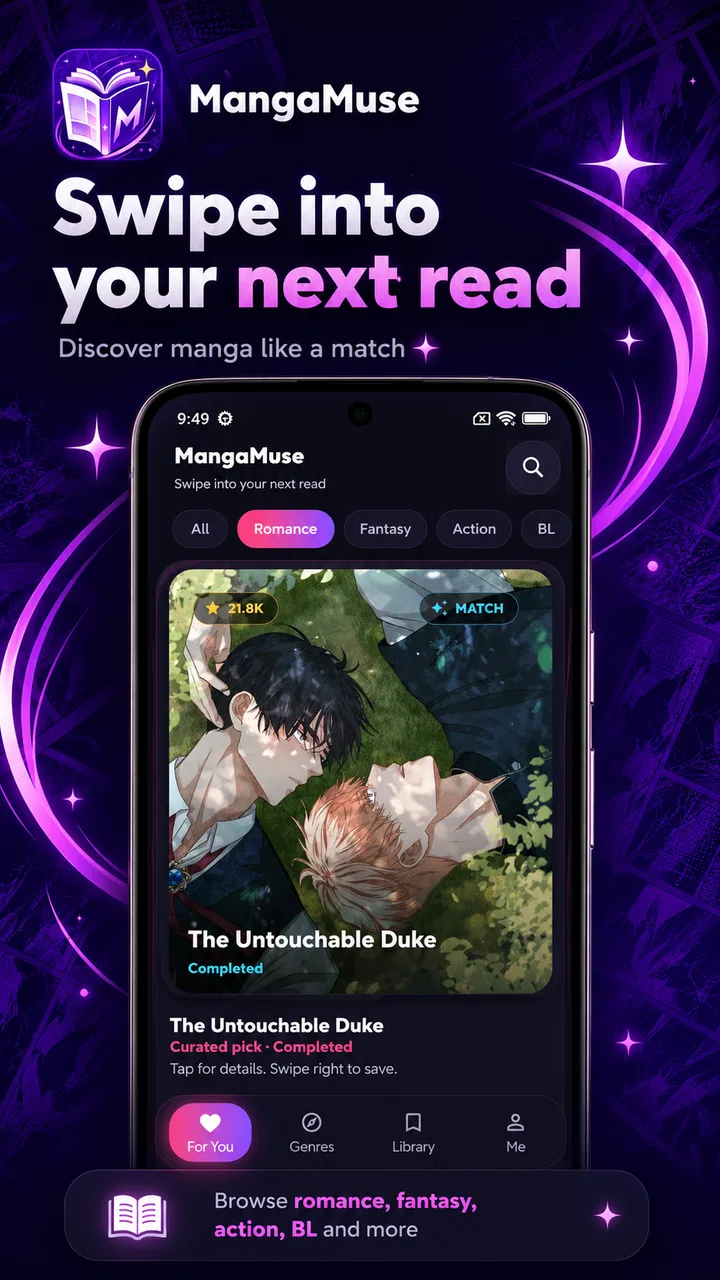
The first thing I noticed is that MangaMuse is built around browsing rather than making me plan everything before I start. That matters for a new user. I do not always know the exact title I want to read, especially when I have a few spare minutes and simply want to find something interesting. The app’s swipe-to-save approach makes that kind of casual discovery feel more deliberate: I can look at a title, decide whether it belongs in my personal shortlist, and continue without interrupting the flow with a complicated filing system.
The dark theme is more than a cosmetic choice for this type of app. Comic covers and panels tend to stand out against a darker background, and the interface feels less harsh when I use it in a dim room. I still would not treat any dark interface as a substitute for sensible screen brightness, but the presentation suits late-night reading better than a bright white catalog. If you prefer a very airy, paper-like design, the visual mood may feel less natural, yet readers who already use dark modes elsewhere will probably settle in quickly.
My advice for a first launch is to resist the urge to save everything that looks attractive. The swipe gesture is quick, which is useful, but quick decisions can produce a messy favorite list. I had a better experience when I treated saved items as a short queue of things I genuinely wanted to revisit. That small habit turns the app from a stream of covers into a practical starting point for the next reading session.
The first setup is intentionally light
For a first-time user, the lack of a long preparation ritual is a strength. You can begin by looking through the available comics, using the cover and title as your first clues, and saving the entries that catch your attention. I prefer this to an app that asks me to build elaborate shelves before I have even seen what it offers. MangaMuse makes more sense when I let the catalog teach me how I want to use it.
There is also a useful distinction between discovering a comic and committing to read it immediately. A title can look appealing but still be wrong for my mood, available time, or preferred format. Saving it gives me a pause button. I can continue exploring without losing the idea, then return later when I am ready to give it proper attention. That workflow is particularly helpful for readers who often find recommendations while commuting, waiting in line, or taking a short break.
The Teen content rating is worth keeping in mind before handing the app to a younger reader. It does not mean every item will suit every teenager, and it is not a guarantee that all themes will match your household preferences. I would use the rating as a reminder to make individual choices rather than assuming that a general comics label tells me everything about a title.
Your first meaningful success: build a small, usable shortlist
The first moment when the app became genuinely useful for me was not opening a random comic. It was saving a handful of titles with different purposes: one for a short session, one for a longer read, and one that I saved simply because its premise looked unusual. This gave the favorites area a job. Instead of asking myself what to search for every time I opened the app, I had a small set of possibilities ready to inspect.
The swipe gesture works best when I use it as a fast decision tool rather than a substitute for reading a description carefully. I pause long enough to identify why I am saving something. Is the artwork appealing? Is the format convenient? Does the title fit the mood I want tonight? A favorite list created with those questions in mind is easier to trust than one filled through automatic, thoughtless swiping.
For a realistic everyday scenario, imagine having ten minutes before an appointment. I would open MangaMuse, browse until one or two covers stand out, save anything that deserves a closer look, and then leave. I would not expect to finish a long chapter in that situation. The app still earns its place because it turns idle time into organized discovery. Later, at home, I can open the saved list and choose without repeating the same browsing process.
Another useful workflow is to use favorites as a temporary research board. If I am trying to decide what kind of manga or webtoon I want next, I can save titles from different visual styles or story categories, compare them later, and remove the ones that no longer interest me. This is a modest feature, but it prevents the common problem of remembering that a title looked promising while forgetting its name.
Where new users may become confused
The biggest adjustment is understanding what the app is best at. MangaMuse presents itself as a discovery and reading companion, so I would not approach it expecting the depth of a dedicated digital library, the editorial guidance of a major publisher platform, or the social activity of a community app. If your priority is a very large ecosystem with extensive account tools, reading history, creator interaction, or highly detailed organization, a more established alternative may suit you better.
The swipe-to-save interaction can also create uncertainty at first. A swipe feels final even when the real intention is only to move through the catalog. I recommend slowing down during the first few minutes and checking where saved items appear before developing a fast rhythm. Once I understood that the gesture was mainly about sorting interest, it became more comfortable. Before that, I worried that I might lose track of titles simply by moving too quickly.
Another point of friction is the difference between a saved favorite and a completed reading decision. Saving something does not necessarily mean it has become my next read. It is better to think of the list as a set of leads. I still need to choose based on time, mood, and whether I want a familiar style or something new. That extra decision is not a flaw unique to this app, but the quick browsing design can make the list grow faster than expected.
Readers who rely on precise filtering may find the experience less satisfying than those who enjoy visual exploration. I often want to narrow a catalog by several conditions at once, especially when I know I need a short series or a particular tone. MangaMuse’s strongest idea is the swipeable discovery loop, so users who prefer to enter exact criteria and receive a tightly controlled result may feel that the process is too open-ended.
How it compares with familiar alternatives
Compared with reading directly through a publisher or subscription service, MangaMuse feels more like a lightweight front door to comic discovery. Dedicated services are usually the better choice when I already know the exact series I want, need a dependable long-term library, or care about a full set of reading-management tools. Their advantage is depth and continuity. MangaMuse’s advantage is the low effort required to browse and keep promising titles together.
Compared with a general web browser, this app gives the activity a more focused shape. A browser can reach almost anything, but it also leaves me managing tabs, bookmarks, and scattered recommendations. The swipe-to-save model gives MangaMuse a clearer purpose: look, decide, and retain the titles that deserve another visit. The trade-off is flexibility. A browser remains better for researching a specific creator, comparing sources, or moving freely between unrelated pages.
It also differs from a basic note-taking app used to record comic names. Notes can store a list, but they do not provide the same visual browsing rhythm. On the other hand, notes are better when I want to add personal comments such as “read this after volume two” or “check the translation later.” I would use MangaMuse for discovery and a separate note only if my tracking needs became unusually detailed.
That comparison helped me place the app correctly. It is not trying to replace every part of a reader’s routine. It is most convincing as a compact discovery layer for people who want to turn browsing into a manageable shortlist without spending time designing a complicated library.
Practical habits that make the app more useful
My first tip is to keep the saved list selective. A small list creates a real next step, while an enormous list recreates the problem the app was meant to solve. Every few sessions, I would review the oldest saved items and remove anything that no longer appeals to me. This is especially important because quick swiping makes accumulation effortless.
My second tip is to separate discovery sessions from reading sessions. When I combine both, I tend to save too much and read too little. A short discovery session can focus on finding possibilities; a later session can focus on choosing one title and giving it uninterrupted attention. That division makes the app feel calmer and gives the favorites feature a clearer purpose.
My third tip is to judge the interface on your actual device rather than assuming that a dark theme will solve every comfort issue. On a compact phone, covers and text may feel more crowded than they do on a larger display. If you read for a long time, hold the device at a comfortable distance and adjust brightness manually. The app’s presentation helps, but reading comfort still depends on the hardware and your surroundings.
A fourth useful approach is to save by mood instead of by vague popularity. I might create an informal mix of titles for a quick laugh, a serious story, and a visually distinctive series. Even without elaborate labels, that mental grouping makes the next choice faster. It also prevents me from opening the app only when I already know exactly what I want, which would underuse its discovery strength.
Who should install it, and who should skip it
I would recommend MangaMuse to a casual manga or webtoon reader who enjoys browsing, wants a dark reading environment, and needs a simple way to remember interesting titles. It is also a good fit for someone who regularly discovers comics in short bursts and dislikes keeping a scattered list of browser bookmarks. The free price makes trying it low-risk, and the older Android requirement means it does not demand a recent phone simply to get started.
I would be more cautious if you want a complete, highly organized reading service. Users who expect advanced sorting, a deep personal library, detailed progress management, or a strong community layer should compare it with specialized alternatives before making it their main app. I would also skip it if I dislike visual browsing and prefer to search by exact metadata every time. The app’s central interaction is a benefit only when that style of discovery feels natural to me.
Parents and guardians should also take the Teen rating seriously and make choices title by title. A comics app can contain very different moods and themes under one broad category. The rating is a useful starting point, but personal suitability still matters more than the label alone.
My next step after the first session
Once I had a useful shortlist, I stopped treating the app as something to open endlessly. I used it as a launchpad: browse briefly, save selectively, then return to one promising title when I had the time to read. That approach kept the experience from becoming an endless stream of covers and made the app feel more purposeful.
The current version, 1.7.1, is the one I would use when evaluating the experience today. I would still keep expectations realistic: the app’s appeal comes from its streamlined comic discovery, not from a claim that it can replace every established reading platform. Its free access removes the biggest barrier to experimentation, while the Teen rating and focused category make its intended audience fairly clear.
In the end, MangaMuse:AceToon Lite & Comic works best when I want a friendly way to discover manga and webtoons without turning the process into library administration. The dark presentation is comfortable, the save gesture gives browsing a practical outcome, and the lightweight setup is reassuring for first-time users. Its limitations become more visible when I demand deep organization or exact, research-style filtering. For casual discovery and a tidy personal shortlist, though, I think it is worth trying—especially if you approach it with one simple goal: find a few titles you genuinely want to read next, rather than save everything you see.
FAQs for MangaMuse:AceToon Lite & Comic
01What is MangaMuse: AceToon Lite & Comic?
MangaMuse: AceToon Lite & Comic is a mobile reading app focused on manga, manhwa, webtoons, and digital comics. Its interface is designed for browsing titles, opening individual chapters, and reading on a phone or tablet. Before downloading, remember that the available catalog, language options, and reading features can vary by region and may change as the app receives updates.
02Is MangaMuse: AceToon Lite & Comic free to use?
The app can generally be downloaded and used without an upfront purchase, but free access does not necessarily mean that every title or chapter is available at no cost. Some content may be supported by advertising, limited by reading credits, or placed behind optional purchases or subscriptions. Check the in-app pricing and payment information before unlocking premium chapters.
03Does the app offer manga and comics in English?
MangaMuse: AceToon Lite & Comic may include English-language content, but the exact selection depends on the publisher agreements, region, and current catalog. Titles can also differ in translation quality, update frequency, and chapter availability. If reading in English is important to you, review the language labels and sample chapters in the app before committing to a series.
04Can I read comics offline with MangaMuse: AceToon Lite & Comic?
Offline reading depends on the version of the app and the permissions provided for each title or chapter. Some reading platforms allow chapters to be temporarily downloaded, while others require an active internet connection for loading pages, advertisements, or access verification. It is best to test the download option on a free chapter and confirm how much storage the files use.
05Is MangaMuse: AceToon Lite & Comic safe for children?
Parents should not assume that every title in MangaMuse: AceToon Lite & Comic is suitable for children. Manga and webtoon catalogs commonly include different age ratings, mature themes, violence, romance, or suggestive material. Review the app-store rating, privacy policy, content labels, and available parental controls, and supervise younger users when necessary, particularly if the app includes advertising or in-app purchases.
Pros
- Large selection of manga
- manhua
- manhwa
- and webcomics
- Clean reader layout makes chapters comfortable to follow
- Useful search and category filters help discover new series
- Regular content updates keep the library feeling fresh
- Lite design can perform well on many Android devices
Cons
- Some titles or chapters may be unavailable in certain regions
- Ad interruptions can reduce reading comfort for free users
- Translation quality may vary between different series
- Offline reading options may be limited or unavailable
- The app may request permissions users do not expect

MangaMuse:AceToon Lite & Comic
Gallery